

Search is changing. People are no longer relying only on traditional Google results to find information, compare companies, or make purchasing decisions. They are increasingly using Google AI Overviews, ChatGPT, Gemini, Perplexity, Microsoft Copilot, and other AI-powered platforms to get direct answers.
That shift has created a new opportunity for businesses: Answer Engine Optimization (AEO).
AEO helps make your website, content, and brand information easier for answer engines to understand, trust, retrieve, and potentially cite in AI-generated answers.
It does not replace traditional SEO. Instead, it expands SEO to include visibility across the growing world of AI search.
What Is Answer Engine Optimization (AEO)?
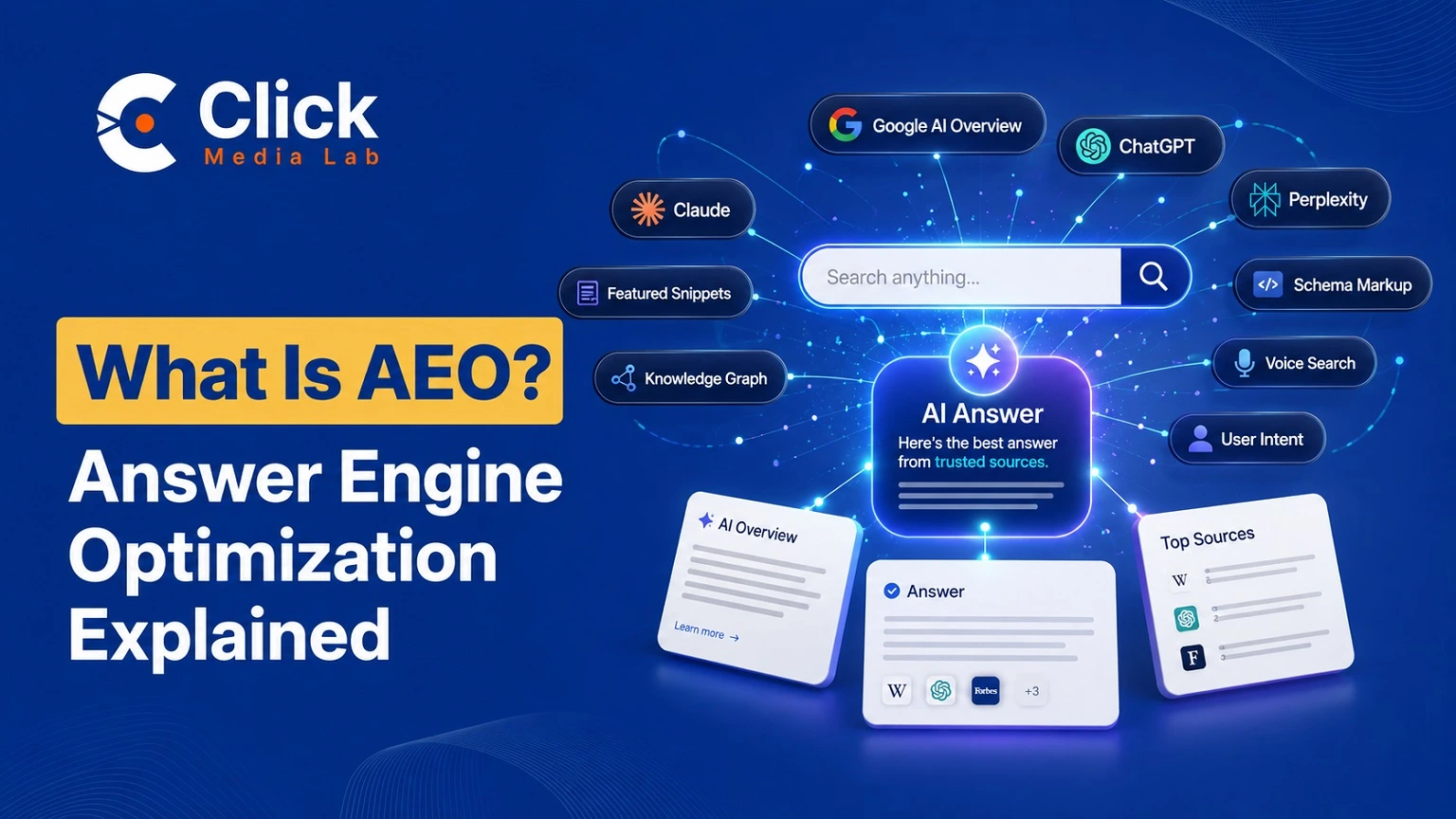
Answer Engine Optimization is the process of optimizing website content and online brand information so search engines and AI platforms can easily understand, retrieve, and use it when generating direct answers.
Traditional SEO focuses heavily on ranking webpages in organic search results. AEO also focuses on whether your information can become part of the answer itself.
For example, AEO can help increase your chances of appearing in:
- Google AI Overviews
- Google AI Mode
- ChatGPT answers
- Perplexity results
- Gemini responses
- Microsoft Copilot
- Voice and conversational search
- AI-powered product recommendations
A successful answer engine optimization strategy focuses on clear answers, authoritative information, technical accessibility, strong brand signals, and trustworthy third-party references.
What Is an Answer Engine?
An answer engine is a search or AI system that tries to provide a direct response to a user’s question instead of simply displaying a list of webpages.
Traditional search might show ten links for:
“What is local SEO?”
An answer engine may instead explain local SEO directly, summarize the major factors, and cite several sources supporting the answer.
Modern answer engines can use search indexes, live web retrieval, structured information, trusted publishers, business information, and other sources to construct responses.
This changes how businesses need to approach search visibility.
Why Does Answer Engine Optimization Matter?
Website rankings and organic traffic are still important, but more searches are being answered directly within search engines and AI platforms.
A potential customer might ask:
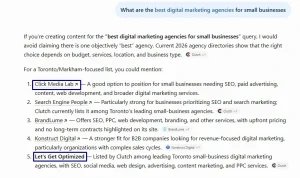
“What are the best digital marketing agencies for small businesses?”
Instead of visiting ten agency websites, they may receive a shortlist directly from an AI assistant.
Being included in that answer creates valuable brand exposure even if the user does not immediately click your website.
AEO can help businesses improve:
- AI search visibility
- Brand discovery
- AI citations
- Product and service recommendations
- Brand authority
- High-intent customer exposure
- Branded searches
- AI referral traffic
This matters for both large companies and local businesses.
A local company with accurate business information, strong reviews, useful content, and consistent online profiles may have a better chance of appearing when someone asks an AI assistant for a recommended provider nearby.
How Does AEO Work?
While every AI platform works differently, Answer Engine Optimization can be understood through four basic stages:
Retrieval → Selection → Synthesis → Attribution
Retrieval
The system first needs to discover information that may help answer the question.
Sources may include:
- Search engine indexes
- Websites
- Product databases
- Business profiles
- Third-party publications
- Review platforms
- Structured data
- Other relevant online sources
This is why crawlability, indexability, SEO, internal linking, and technical accessibility remain important.
Selection
Once relevant sources are found, the system needs to determine which information best supports the answer.
This is where passage-level optimization becomes important.
A page may cover twenty topics, but one clearly written paragraph might provide exactly the information needed for a particular question.
Important sections should therefore be clear enough to understand without requiring the reader to search through the entire article.
Synthesis
AI platforms can combine information from multiple sources into one response.
For example, an answer may use:
- A statistic from a research study
- Product information from a manufacturer
- A comparison from an industry publication
- Reviews from another website
- A definition from an expert source
Your website does not always need to provide the entire answer. It can become the strongest source for one important part of it.
Attribution
The system may then decide which sources or organizations should be cited or mentioned.
This is where brand authority becomes important.
Information about your company may come from both your website and independent sources across the web.
AEO vs. SEO vs. GEO vs. ASO
These terms overlap, but they are not exactly the same.
| Strategy | Main Goal |
|---|---|
| SEO | Rank webpages and increase organic search traffic |
| AEO | Get information included in direct and AI-generated answers |
| GEO | Improve brand visibility across generative AI platforms |
| Agentic Search Optimization | Help AI agents evaluate, recommend, or act on business and product information |
AEO vs. SEO
SEO helps search engines discover, crawl, understand, and rank webpages.
AEO builds on that foundation by making information easier to use within direct answers.
Technical SEO, backlinks, content quality, site architecture, and authority still matter.
The best strategy is therefore not SEO or AEO.
It is SEO + AEO.
AEO vs. GEO
Generative Engine Optimization (GEO) focuses broadly on visibility inside generative AI platforms.
AEO focuses more specifically on helping content become useful for answering questions.
In practice, the strategies overlap considerably.
Strong content, authority, entity clarity, structured information, technical accessibility, and third-party mentions support both.
What Is Agentic Search Optimization?
Agentic Search Optimization focuses on AI systems that can move beyond answering questions and begin helping users perform tasks.
For example:
Answer: “These are the best hotels in Toronto.”
Recommendation: “Hotel A is probably best for your requirements.”
Agentic action: “Find me a hotel under $250 near downtown that is available Friday night.”
As AI systems become more capable of comparing products, checking availability, making recommendations, and assisting with purchases, accurate business and product information will become increasingly important.
How to Find Questions for AEO
Traditional keyword research is useful, but AEO SEO research should also focus on real questions and conversational prompts.
Useful sources include:
- Google People Also Ask
- Google search suggestions
- Keyword research tools
- Customer support conversations
- Sales calls
- Customer reviews
- Competitor content
- Reddit and industry forums
- ChatGPT
- Gemini
- Perplexity
- Other AI platforms
Do not research only basic informational questions.
Also identify commercial questions such as:
- What is the best provider for…?
- X vs. Y: which is better?
- How much does X cost?
- Which company offers…?
- What should I look for when choosing…?
- What are the best alternatives to…?
- Which service is best for a small business?
One initial question can also create several follow-up questions.
For example:
“What is the best CRM for small businesses?”
may lead to:
- Which CRM is easiest to use?
- Which CRM is cheapest?
- Which one offers automation?
- Which is best for 20 employees?
- HubSpot vs. Salesforce: which is better?
- What does CRM software cost?
Strong AEO content anticipates these follow-up questions naturally.
How to Optimize Content for Answer Engines
AEO does not require writing robotic content.
The goal is to make information exceptionally clear for both people and machines.
Use Answer-First Writing
If a heading asks a question, give the direct answer immediately.
Instead of spending several paragraphs introducing the topic, provide a concise explanation first and then expand.
Use Clear H2 and H3 Headings
Headings should clearly explain what the section contains.
Use:
How Does Answer Engine Optimization Work?
instead of:
How It Works
Descriptive headings improve navigation and make individual sections easier to understand.
Create Self-Contained Sections
Important paragraphs should make sense even when read separately.
Avoid vague statements such as:
“This is why it is important.”
Instead, explain the subject directly:
“Consistent business information helps search engines and AI systems associate your website, profiles, reviews, and citations with the same organization.”
Use Simple Formatting
Helpful formatting includes:
- Short paragraphs
- Bullet points
- Numbered steps
- Clear definitions
- Descriptive headings
- Comparison tables when necessary
A short 40–60 word explanation can work well for direct definitions, but it should not be treated as a strict AEO rule.
Clarity matters more than word count.
How E-E-A-T Supports Answer Engine Optimization
AI search creates an even stronger reason to publish information that offers genuine expertise rather than repeating what already exists online.
Strong content can demonstrate:
- First-hand experience
- Subject-matter expertise
- Author credentials
- Expert review
- Original research
- Real examples
- Case studies
- Testing
- Statistics
- Reliable citations
- Transparent methodology
The strongest information is often:
easy to understand + specific + well-supported + difficult to dispute
For example, saying:
“Content marketing improves results.”
offers little unique value.
A detailed case study explaining the strategy, timeline, results, challenges, and methodology gives readers and other publishers something much more useful to reference.
Create Original Research Worth Citing
One of the best ways to strengthen AEO authority is to produce information that other websites have a reason to cite.
Examples include:
- Original surveys
- Industry studies
- Internal data
- Benchmarks
- Experiments
- Expert interviews
- Unique statistics
- New comparisons
- Detailed case studies
Consider a company that publishes an original industry report based on data from 500 customers.
Industry blogs reference the statistics. A trade publication discusses the findings. Experts share the study. Some websites link back to the original research.
This can create a valuable cycle:
Original research → third-party coverage → backlinks and brand mentions → stronger authority → more opportunities for AI citations
It does not guarantee an AI citation, but it gives your business information worth citing.
How Brand Mentions Improve AEO Visibility
Your website is not the only place AI systems may encounter information about your company.
Third-party authority can come from:
- News publications
- Industry websites
- Reputable blogs
- Expert roundups
- Podcasts
- Professional directories
- Review platforms
- Trade associations
- Research publications
- Relevant forums
- Reddit discussions
- Educational resources
There is also an important difference between different authority signals.
Backlinks point directly to your website.
Brand mentions discuss your company even when no link exists.
Citations attribute information to your company or content.
Reviews provide customer or third-party evaluation.
Entity signals help systems understand who your company is and what it does.
The goal should be legitimate third-party recognition.
Do not spam Reddit, Wikipedia, forums, reviews, or low-quality directories simply to create artificial mentions.
Keep AEO Content Fresh
Outdated information reduces usefulness and trust.
Review important content regularly, especially pages covering:
- Software
- AI platforms
- Pricing
- Statistics
- Regulations
- Product information
- Tools
- Industry trends
Updates may include:
- Replacing old statistics
- Removing outdated recommendations
- Updating platform information
- Updating screenshots
- Fixing broken links
- Revising pricing
- Updating examples
When a meaningful update is made, displaying an accurate Last Updated date can help readers understand how current the information is.
Structured information such as datePublished and dateModified should also remain accurate.
Freshness alone does not guarantee AI visibility. It simply ensures your information remains useful.
Technical SEO for AEO
Technical SEO remains a foundation of AI search optimization.
Review:
Crawlability
Make sure important content is accessible to the search and AI platforms you want to participate in.
Check:
- Robots.txt
- Firewalls
- CDN settings
- Bot protection
- Authentication restrictions
Indexability
Review:
noindex- Canonicals
- Redirects
- Duplicate URLs
- HTTP errors
- Soft 404 pages
Internal Linking
Important pages should receive contextual internal links from related pages.
Create strong connections between:
- Service pages
- Supporting blogs
- Product pages
- Location pages
- Research
- Case studies
JavaScript
Make sure important content is not hidden behind JavaScript that search engines cannot reliably access.
Page Performance
Keep pages mobile-friendly, easy to navigate, fast, and accessible.
A citation is much less valuable if the visitor reaches a poor website experience.
Does Structured Data Help AEO?
Structured data can make information easier for machines to understand, but it is not an AI ranking shortcut.
Useful schema types may include:
- Organization
- LocalBusiness
- Article
- Product
- Person
- Review
- BreadcrumbList
- Service
Useful properties can include:
- Author
datePublisheddateModifiedsameAs- Business information
- Product information
Schema should accurately represent the content users can see on the page.
Do not add fake reviews, inaccurate services, or misleading business information.
Entity Consistency for Answer Engine Optimization
Your company information should remain consistent throughout the web.
Important information includes:
- Business name
- Address
- Phone number
- Website
- Service areas
- Categories
- Products
- Services
- Company description
- Key people
Check your:
- Website
- Google Business Profile
- Social profiles
- Directories
- Review platforms
- Industry websites
- Publisher profiles
Small wording differences are fine.
Conflicting facts are the real problem.
Consistent entity information makes it easier to connect different mentions and profiles with the same organization.
Google AI Overviews vs. ChatGPT vs. Other Answer Engines
Do not assume every AI search platform works exactly the same way.
Google AI Overviews and AI Mode
Google’s AI search features are closely connected to Google’s existing search infrastructure.
Strong SEO fundamentals therefore remain important, including crawlability, indexability, useful content, internal linking, and authority.
ChatGPT
ChatGPT can use web search when current information is required and may cite sources directly.
Publishers should therefore make public content technically accessible if they want it eligible for search-based discovery.
Perplexity
Perplexity is strongly focused on web-grounded answers and frequently displays citations alongside responses.
Clear sourcing and authoritative content are especially valuable in this environment.
Gemini and Microsoft Copilot
Both platforms can use search and web information in different product experiences.
The key lesson is simple:
Build one strong AEO foundation, but measure each platform separately.
How to Measure AEO Success
Traditional keyword rankings alone cannot measure AEO.
Track:
- AI brand mentions
- AI citations
- Citation frequency
- Mention frequency
- AI visibility
- Share of voice
- Competitor visibility
- Platforms mentioning your company
- Topics where your brand appears
- Citation sources
- AI referral traffic
- Branded search demand
- Leads
- Conversions
- Revenue
AEO measurement has limitations.
AI answers can change depending on:
- Platform
- Location
- Prompt wording
- User context
- Model updates
- Search results
- Conversation history
For that reason, avoid claiming your company has a permanent “#1 ChatGPT ranking.”
Track visibility across a consistent group of prompts instead.
How to Track AEO Prompts
A simple manual tracking process can provide valuable insights.
1. Build a List of Customer Prompts
Include informational, comparison, recommendation, and commercial questions.
2. Organize Prompts by Topic
Group prompts around products, services, problems, industries, and customer needs.
3. Assign Funnel Stage
Use categories such as:
- Awareness
- Consideration
- Comparison
- Decision
4. Test Major AI Platforms
Check the platforms that matter most to your audience.
5. Record Brand Mentions
Track whether your company appears.
6. Record Citations
Record whether your website is used as a source.
7. Record Competitors
Identify which businesses appear when yours does not.
8. Record Context
Was your company recommended, compared, mentioned positively, or simply listed?
9. Record Sources
Identify which third-party websites are frequently supporting recommendations.
10. Repeat the Process
Run the same prompt set regularly and compare changes over time.
Useful commercial prompts include:
- Best provider for…
- Top companies for…
- X vs. Y
- How much does X cost?
- Which company offers…?
- What should I look for when choosing…?
- Recommended services for…
Common Answer Engine Optimization Mistakes
Avoid these common AEO mistakes:
Treating AEO as Separate From SEO
Strong SEO remains the technical and content foundation for AI visibility.
Burying Important Answers
Give readers the direct answer before unnecessary background information.
Publishing Thin AI Content
Generic AI-generated articles rarely create meaningful differentiation.
Add expert knowledge, real examples, research, and original insights.
Ignoring Technical Problems
Excellent content cannot perform well if important crawlers cannot access it.
Ignoring Third-Party Authority
Do not rely entirely on what your own website says about your company.
Build genuine authority elsewhere.
Using Schema as a Shortcut
Structured data improves clarity but does not guarantee citations.
Ignoring Content Freshness
Regularly update important statistics, products, recommendations, and platform information.
Creating FAQs Only for Search Engines
FAQs should answer genuine customer questions instead of stuffing additional keywords onto the page.
Tracking Only Traffic
AEO visibility can influence brand awareness before the click.
Track mentions, citations, branded searches, leads, and conversions as well.
Expecting Guaranteed AI Placements
No ethical AEO strategy can guarantee permanent placement in ChatGPT, Google AI Overviews, or another generative platform.
Turn Your Business Into a Trusted Source for AI Search
Answer Engine Optimization (AEO) is not about manipulating ChatGPT, Google AI Overviews, or other AI platforms. It is about making your business information easier for search engines and AI systems to find, understand, trust, verify, and reference.
At Click Media Lab, our AEO services combine SEO, clear answer-focused content, technical accessibility, original expertise, entity consistency, third-party authority, and ongoing performance measurement to strengthen your visibility across traditional search and AI-powered search experiences.
Whether you want to improve your chances of appearing in Google AI Overviews, ChatGPT recommendations, featured answers, or other generative search results, our team can build an AEO strategy tailored to your business, industry, and target audience.
Ready to improve your visibility in AI search? Contact Click Media Lab today to get started with our AEO services.
Frequently Asked Questions About AEO
What Does AEO Stand For?
AEO stands for Answer Engine Optimization, the practice of optimizing content and brand information for direct answers and AI-powered search experiences.
Is AEO Replacing SEO?
No. AEO builds on traditional SEO. Crawlability, indexing, relevance, authority, technical performance, and useful content remain essential.
How Do I Get Cited by ChatGPT?
There is no guaranteed method. Publish accessible, authoritative, useful, and current information while building credible third-party recognition around your brand.
How Do I Get Into Google AI Overviews?
Focus on strong SEO fundamentals, technically accessible content, trustworthy information, topical depth, and clear answers. There is no special submission process that guarantees inclusion.
Does Schema Markup Help AEO?
Schema can help machines understand your information, but structured data does not guarantee AI citations or rankings.
Do I Need llms.txt?
It should not be treated as a universal AEO requirement. Focus first on proven fundamentals such as crawlability, content quality, authority, and accurate information.
How Long Does AEO Take?
There is no fixed timeline. Technical changes may take effect relatively quickly after crawling, while building authority, mentions, research, and reputation can take several months.
Is AEO Useful for Local Businesses?
Yes. Local companies can benefit from accurate business information, strong reviews, local content, credible citations, clear service information, and consistent online profiles.